

October 29, 2025
Your water heater and boiler work every day to give you hot showers, clean dishes, laundry support, and in many homes, steady heating. Because they run so often, even small improvements in water heater efficiency can lower energy costs, reduce noise, improve comfort, and extend equipment life. When water heater efficiency drops, you’ll notice slower hot water recovery, temperature swings, rising bills, and new sounds from the tank or boiler.
Most people wait until there’s a crisis — no hot water, a leaking tank, or a boiler that can’t keep up. At that point you’re reacting, not preventing. This guide from AOBUTEC – HVAC is here to keep you ahead. We’ll explain how tanks, tankless systems, and boilers really work, what hurts water heater efficiency, which fixes are worth doing, and when it’s time to repair vs replace. You’ll also learn how to speak to a technician so you get answers backed by real measurements, not guesses.
If you stay on top of the fundamentals — temperature settings, insulation, scale buildup, circulation control, vent safety, and proper sizing — you can dramatically improve water heater efficiency without changing how you live.
How Your System Heats Water (And Why It Affects Efficiency)
Before you can improve water heater efficiency, it helps to understand what you’re actually working with. Most homes fall into one of three setups: a tank-style water heater, a tankless (on-demand) water heater, or a boiler system that also produces domestic hot water.
Each of these behaves differently. Each has different weak points. And each demands a different strategy to maintain water heater efficiency over the long term.
Tank-Style Water Heaters
A tank-style water heater stores a fixed volume of hot water and keeps it near your temperature setting so it’s ready on demand. The downside is what’s called standby loss. Even a well-insulated tank loses heat to the surrounding space, especially if it’s in a cool basement or mechanical room. The water slowly cools. The thermostat senses that drop. The burner or electric heating elements turn back on. You pay for that reheating, even if nobody is showering, washing dishes, or running laundry.
This cycle repeats all day and all night. That constant reheating is one of the biggest reasons water heater efficiency can suffer in older tanks. You’re essentially paying to maintain a reservoir of hot water at all times, even when you’re not home.
Improving insulation around exposed hot water piping, keeping the system tuned, and controlling temperature settings can dramatically improve water heater efficiency in tank-style systems.
Why Insulation And Location Matter
The location of the tank matters more than most people think. If your tank is in a cold utility area, it’s losing heat faster than one located in a semi-conditioned space. The faster it loses heat, the more often it refires, and the lower your water heater efficiency becomes.
Older tanks (not modern high-efficiency insulated models) can sometimes benefit from an insulating jacket. That slows surface heat loss and helps you maintain water heater efficiency with fewer reheats. Just make sure the jacket is approved for your specific style of tank. Some newer high-efficiency tanks already have thick factory insulation and are not meant to be wrapped.
Just as important: insulate the first few feet of hot water piping leaving the heater. Bare copper or PEX piping acts like a little radiator, constantly bleeding heat you’ve already paid for into the air. Pipe insulation helps keep that heat in the water longer, reduces standby cycling, and directly supports water heater efficiency.
Tankless (On-Demand) Water Heaters
Tankless systems heat water only when you open a tap. On paper, that sounds perfect for water heater efficiency — no tank of hot water sitting around losing heat. In practice, it’s a little more nuanced.
Tankless units rely on heat exchangers to raise water temperature instantly as it flows through the unit. Over time, minerals from the water supply build up on that heat exchanger. That buildup (scale) is like a blanket that blocks heat transfer. When scale is heavy, the burner (or electric element) has to work harder to hit your temperature target, which lowers real-world water heater efficiency. You’ll notice this problem as outlet temperature swings, lukewarm water when more than one fixture is running, or unusually loud operation.
Descaling (a professional cleaning process that removes mineral buildup inside the unit) restores proper heat transfer and helps bring water heater efficiency back where it should be.
There’s also a capacity limit. Every tankless unit has a maximum flow rate in litres per minute. If multiple showers, a dishwasher, and laundry all demand hot water at once, the unit might run at full output nonstop. When it’s maxed out like that, you’re still using a lot of energy, and water heater efficiency in that moment depends on whether the unit is sized correctly for your household.
Boiler Systems With Indirect Or Integrated Domestic Hot Water
In many Canadian homes with hydronic heat (radiators, baseboards, in-floor loops), the boiler also makes domestic hot water. When tuned properly, one boiler can heat your space and keep showers hot with strong water heater efficiency. When it’s not tuned, it can waste fuel all day in the background.
Control is the difference. If the boiler runs at high temperature all the time, even on mild days, it burns more energy than needed. Outdoor reset solves this by letting the boiler run cooler water when it’s warmer outside and only ramp up in real cold. That cuts waste and supports consistent water heater efficiency.
Watch for short cycling too. Short cycling is when the boiler keeps turning on and off in quick bursts instead of running smoothly. That wastes fuel, wears parts, creates temperature swings, and drags down water heater efficiency. Good pump control and zoning help prevent it.
Temperature Settings And Safety
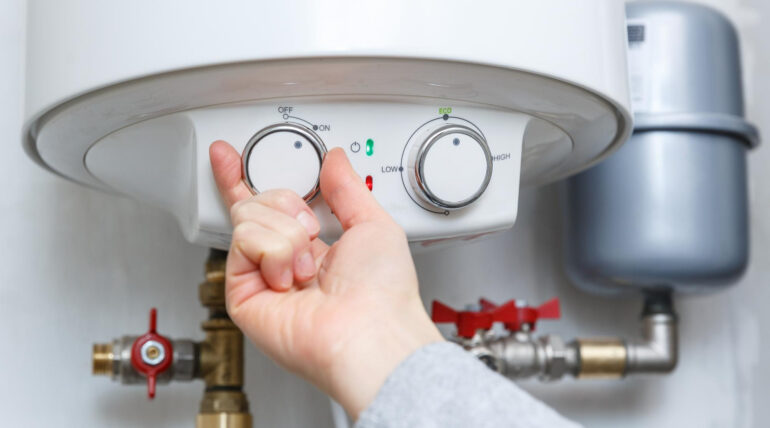
Many people think “hotter is better,” but turning your water temperature up too high can actually hurt water heater efficiency. The hotter you keep the tank, the more often it reheats, and the faster scale builds up — both waste energy.
Most homes are comfortable around 49–54°C (120–130°F). In that range, you avoid scald risk and you’re not burning energy to keep water hotter than you’ll really use. That helps water heater efficiency because the system cycles less often.
Going too low isn’t perfect either. Very low temperatures can allow bacteria growth and force the tank to reheat more often because you’re using mostly straight hot water. A mixing valve is the smart solution. It stores water at the right performance temperature, blends it with cold before it reaches your tap, and gives you safe, steady hot water while protecting long-term water heater efficiency.
Recirculation Pumps: Comfort vs Waste
Some houses and condos use a hot water recirculation loop so you get hot water at a distant tap almost instantly. The convenience is great. The catch is that many recirculation pumps run nonstop. When hot water constantly circulates through the plumbing loop, you’re dumping heat into the lines 24/7 — even while you sleep. The water heater keeps reheating that water, and water heater efficiency goes down fast.
You don’t have to give up comfort to fix this. What you want is control. Adding a timer, motion sensor, push-button trigger, or smart recirculation control lets the pump run only when it’s actually needed. You still get fast hot water in the morning or before a shower, but you’re not bleeding energy at 2 a.m. just to save a few seconds at 7 a.m. That balance protects convenience and improves water heater efficiency.
Sediment, Scale, And Internal Buildup
Sediment is one of the biggest threats to water heater efficiency. In a tank, minerals settle at the bottom and harden. That buildup forces the burner or element to work longer and hotter just to raise the water temperature. You’ll hear it as rumbling or popping. Longer run time means higher energy use and more stress on the tank.
Flushing the tank removes that layer, restores proper heat transfer, and usually brings back faster recovery, quieter operation, and better water heater efficiency.
Tankless systems have a similar problem, but instead of sediment on the bottom, minerals coat the heat exchanger. That coating blocks heat transfer, causing temperature swings or lukewarm water under heavy demand. Professional descaling dissolves that buildup and restores water heater efficiency.
Boiler systems can also lose efficiency when sludge or trapped air block circulation in radiators, baseboards, or in-floor loops. Poor circulation forces the boiler to run harder and longer, which wastes fuel and can also slow down domestic hot water production. Cleaning strainers, bleeding air, and flushing hydronic loops keeps circulation smooth and protects overall water heater efficiency.
Fast Wins For Better Performance
Here are 10 smart, high-impact actions that help protect comfort, reduce waste, and improve water heater efficiency:
- Insulate the first few feet of exposed hot water piping coming out of the tank or boiler.
- Put your hot water recirculation pump on a timer, motion sensor, or smart control so it doesn’t run 24/7.
- Keep your storage temperature in a safe, efficient range (around 49–54°C / 120–130°F) and use a mixing valve to stabilize delivery.
- Flush sediment out of tank-style water heaters at least once or twice a year to restore water heater efficiency.
- Descale tankless heat exchangers so they can transfer heat effectively instead of struggling.
- Have radiators, baseboards, or in-floor heating loops bled and cleaned to maintain consistent boiler circulation.
- Replace failing anode rods in storage tanks. A healthy anode rod slows corrosion, extends tank life, and helps maintain water heater efficiency because the heater can operate as designed for longer.
- Keep boxes, paint cans, and other clutter away from the burner area or combustion air intake so the system can breathe and burn cleanly. Clean combustion supports steady water heater efficiency.
- Upgrade to modern low-flow showerheads and faucet aerators. Lower flow per minute means less demand per minute, which protects comfort and supports water heater efficiency without making showers feel weak.
- Track recovery time. Time how long it takes your system to “bounce back” after two showers in a row. If recovery keeps getting slower, that’s an early warning that water heater efficiency is dropping and service is due.
When To Repair And When To Replace
Not every problem means you need a new unit. Sometimes a cleaning, adjustment, or small part swap is enough to bring back water heater efficiency and keep you going for years.
Repair usually makes sense when:
• The tank isn’t leaking.
• The issue is clear and fixable (ignitor, circulator pump, thermostat, scale).
• After service, recovery time and hot water performance go back to normal.
Replacement makes more sense when:
• The tank is leaking or badly rusted.
• Hot water recovery keeps getting slower even after proper flushing.
• The burner, heat exchanger, or control board is failing.
• Your bills keep rising and water heater efficiency keeps dropping.
• The system is at the end of its expected life and close to total failure.
When you replace, you’re choosing more than a box. You’re choosing capacity, venting, control strategy, and (for boilers) circulation for the next decade. A properly sized, properly commissioned system starts efficient on day one. AOBUTEC – HVAC measures recovery rate, flow rate, outlet temperature stability, combustion quality, vent performance, and standby loss so you know whether repair or upgrade is the smarter move for real water heater efficiency.
Safety, Venting, And Canadian Guidance
Water heater efficiency and safety are connected. A gas-fired heater or boiler that can’t draft properly, or doesn’t get enough combustion air, is not only unsafe, it’s also inefficient. Poor combustion wastes fuel, produces soot, and can create a carbon monoxide hazard. Clean, well-vented combustion supports steady performance and stable water heater efficiency.
Canada’s federal guidance reinforces this. Health Canada recommends installing and maintaining carbon monoxide alarms in any home with fuel-burning appliances and near sleeping areas. Natural Resources Canada publishes resources for efficient heating and domestic hot water systems, including how to make informed upgrade decisions. These best practices protect both your safety and your water heater efficiency.
- Natural Resources Canada – Heating And Cooling Systems
- Health Canada – Carbon Monoxide And Home Heating Safety
Why Choose AOBUTEC – HVAC
Improving water heater efficiency is not just “turn the temperature down and hope.” It takes measurement, adjustment, and follow-through. When you call AOBUTEC – HVAC, we don’t just look at your system and say “seems fine.” We test.
Here’s what that looks like in practice:
We measure real performance — inlet and outlet temperatures, flow rate, recovery time — so we can talk about water heater efficiency with data, not guesses.
We restore efficiency by flushing tanks, removing sediment, cleaning burners, and descaling tankless heat exchangers so they heat water properly again.
We check gas pressure, venting, and combustion quality to keep operation safe, steady, and efficient.
We review insulation, recirculation timing, and control strategy so you’re not wasting energy 24/7, especially in boiler-fed homes.
If your system is near end of life, we recommend properly sized, properly vented, properly commissioned replacements designed to start efficient — and stay efficient.
Comfort, Cost, And Safety Are All Connected
When your boiler runs smoothly, when your tank is flushed, when your pipes are insulated and your recirculation pump is controlled, you get steady heat, lower bills, and better water heater efficiency — without stress.
If you’re seeing slow hot water recovery, temperature swings, rumbling, nonstop circulation, or higher energy bills, that’s your warning sign. Book a performance check with AOBUTEC – HVAC. We’ll test, tune, and fix what matters so you get safe, reliable comfort and strong water heater efficiency every day.
Frequently Asked Questions
-
How often should I flush my tank-style water heater to protect water heater efficiency?
About once or twice a year. Flushing removes sediment so the burner or elements can heat water directly and efficiently. -
Does lowering the thermostat always improve water heater efficiency?
Lowering very high temperature settings usually helps, but don’t set it too low. Aim for a safe range and use a mixing valve to balance comfort, hygiene, and water heater efficiency. -
My tankless heater is delivering inconsistent temperature. Is that hurting water heater efficiency?
Yes. Temperature swings often mean scaling or overload. Descaling and proper sizing restore stable output and protect water heater efficiency. -
Can insulating hot water pipes really make a difference in water heater efficiency?
Yes. Insulating exposed hot water lines keeps heat in the water longer, reduces reheating, and improves water heater efficiency. -
My boiler also supplies domestic hot water. Does boiler maintenance affect water heater efficiency?
Absolutely. A poorly tuned boiler wastes fuel and runs harder. Cleaning, bleeding air, and using outdoor reset can boost both heating performance and water heater efficiency. -
Is a hot water recirculation pump bad for water heater efficiency?
It can be if it runs nonstop. Put it on a timer, motion sensor, or smart control so you keep convenience without wasting heat all day. -
When should I replace instead of repair if I want better water heater efficiency?
Replace if it’s leaking, badly corroded, or no longer recovering well even after service. A properly sized new system, installed and commissioned correctly, restores long-term water heater efficiency.